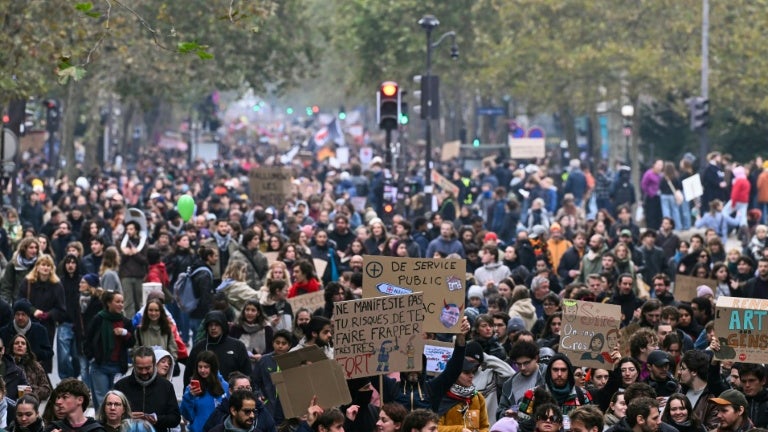
Protest turnout across France dropped markedly on Saturday, November 7, with the Interior Ministry's office reporting 7,000 participants across 68 actions by 14h, BFM reports. The same source described the situation nationwide as "broadly calm and under control," with 18 people taken into custody by that hour, compared with 27 at the same point the previous week.
The figures mark a steep decline from recent weekends. According to the ministry's office, 15,000 people joined 65 actions on Saturday, October 31; 37,000 took part in 108 actions on October 24; and 67,000 attended 198 actions on October 17, BFM reports.
Why it matters
The weekend demonstrations have been a fixture of France's autumn of social discontent, drawing on anger over the cost of living and, in recent weeks, the participation of school students. Saturday's numbers suggest the movement is losing momentum even as unions prepare further action. Sophie Vénétitay, general secretary of the Snes-FSU teachers' union, told BFMTV that a strike call set for Tuesday "keeps the pressure on the government." She said the call also gives lycéens a way to express themselves within a supervised march, and possibly less outside schools, after criticising the exclusion of education staff from a Monday conference on pay at Matignon.
Paris: a smaller march, and a banned gathering at Concorde
In the capital, the Paris police prefecture counted 46,000 people at the march "for youth and against the high cost of living," a clear drop from Thursday's 65,000, according to BFM. The procession set off from Place de la République at 14h12 and reached Place de la Nation in the afternoon, with the prefecture saying the march was due to end at 19h, when officers would call on participants to disperse. BFM's reporter described the crowd as mostly young — lycéens, students and people in their thirties.
Separately, the gilets jaunes coordination held a gathering at Place de la Concorde despite a partial ban ordered by the prefecture, refusing to join the authorised inter-union route. The prefecture put the crowd at around 30 people; BFM's journalist on the scene estimated closer to a hundred, some of them blocked by police from reaching the centre of the square. CRS and BRAV-M units intervened to stop demonstrators assembling in one spot. The prefecture said those present would be fined for breaching the order before being allowed to leave; taking part in a banned protest is a contravention carrying a flat €135 penalty.
Benjamin Ball, a member of the gilets jaunes coordination, and Azelma Sigaux, a spokesperson for the movement, were detained early in the afternoon in front of the Assemblée nationale and placed in custody at the 17th arrondissement police station, according to David Libeskind, the movement's lawyer.
At Concorde, a 20-year-old Parisian named Marie told BFM she cannot get by on her 40-hour week. Gaylord, a 46-year-old father of three from Saint-Malo, raised concerns about the public hospital system and unheated classrooms, and called for direct democracy and a citizen-initiated referendum on the Swiss model. Emna, a 16-year-old lycéenne speaking from République, said she joined the march to denounce police violence and what she described as a lack of response to the protesters' demands.
Lyon tensions, and figures from other cities
Lyon saw the day's most visible friction. No march had been declared there, and the Rhône prefecture told BFMTV that 10 people were initially detained after a gathering formed in the early afternoon. A first group assembled near the Manufacture des Tabacs around 14h and was broken up with tear gas; a larger group then re-formed facing the Pont de la Guillotière and was also being dispersed. The prefecture later reported one further arrest, bringing the total to 11, BFM reports. Officers charged and used a water cannon as the demonstration wound down, a few bins were set alight, and BFM's reporter witnessed several arrests.
In Lille, the Nord prefecture estimated 10,000 demonstrators, while the CGT put the figure at 20,000, according to BFM's journalist on the ground. The Bouches-du-Rhône police prefecture counted 5,200 people in Marseille and 500 in Aix-en-Provence. Nice saw 2,300 participants, per the Alpes-Maritimes prefecture, and about 600 gathered in Clermont-Ferrand, according to the prefecture there, in a cheerful atmosphere on the outskirts of the city centre, where all gatherings had been banned.
Charente Libre reported that mobilisation against the high cost of living also flagged in Angoulême, quoting one participant: "Whether we're two or a thousand, what matters is being here."
Authorised marches in both Paris and Marseille passed off calmly and in good humour, BFM reports.
Attention now turns to Tuesday, when unions have called a strike and student and lycéen organisations plan further action, with the government's social conference on pay at Matignon on Monday likely to shape the mood.